
It can be surprisingly confusing.
Your child opens a book.
They read the page.
The words sound right. They aren't stumbling over every sentence. You may even think, Great! Reading is finally clicking.
Then you ask:
“So…what happened?”
Blank stare.
Or you get one tiny detail from page three.
Or your child starts flipping frantically through the book looking for the “right” answer.
This doesn't necessarily mean your child wasn't paying attention.
Reading the words and making meaning from those words are connected skills, but they aren't exactly the same thing.
And that's actually good news.
Because comprehension can be practiced.
The trick is not turning every book into a quiz.
Reading Isn't Finished When the Words Are Read
When children are learning to read, adults understandably pay a lot of attention to decoding.
Can they sound out the word?
Do they recognize it?
Can they read the sentence smoothly?
But eventually another question becomes just as important:
Did the words create meaning?
Reading comprehension involves skills such as identifying important information, understanding characters and events, making predictions, drawing inferences, recognizing story structure and summarizing ideas.
The Institute of Education Sciences provides family literacy resources that encourage parents to talk with children while reading, ask open-ended questions and revisit relevant parts of a story when a child isn't sure of an answer.
That's a very different experience from:
“What color was his shirt?”
“What was the dog's name?”
“What happened on page six?”
Those questions can check memory.
We're trying to build thinking.
1. Stop Asking “What Was the Story About?”
At least not immediately.
It's an enormous question for a child who is still learning how to organize information.
Imagine someone handing you a two-hour movie and immediately saying:
“Explain it.”
You might need a minute too.
Give your child somewhere smaller to begin.
Try:
Who was the story mostly about?
Then:
What did that person want or need?
Then:
What got in the way?
Then:
What happened in the end?
Suddenly, the child isn't trying to retrieve an entire book from memory.
They're rebuilding it piece by piece.
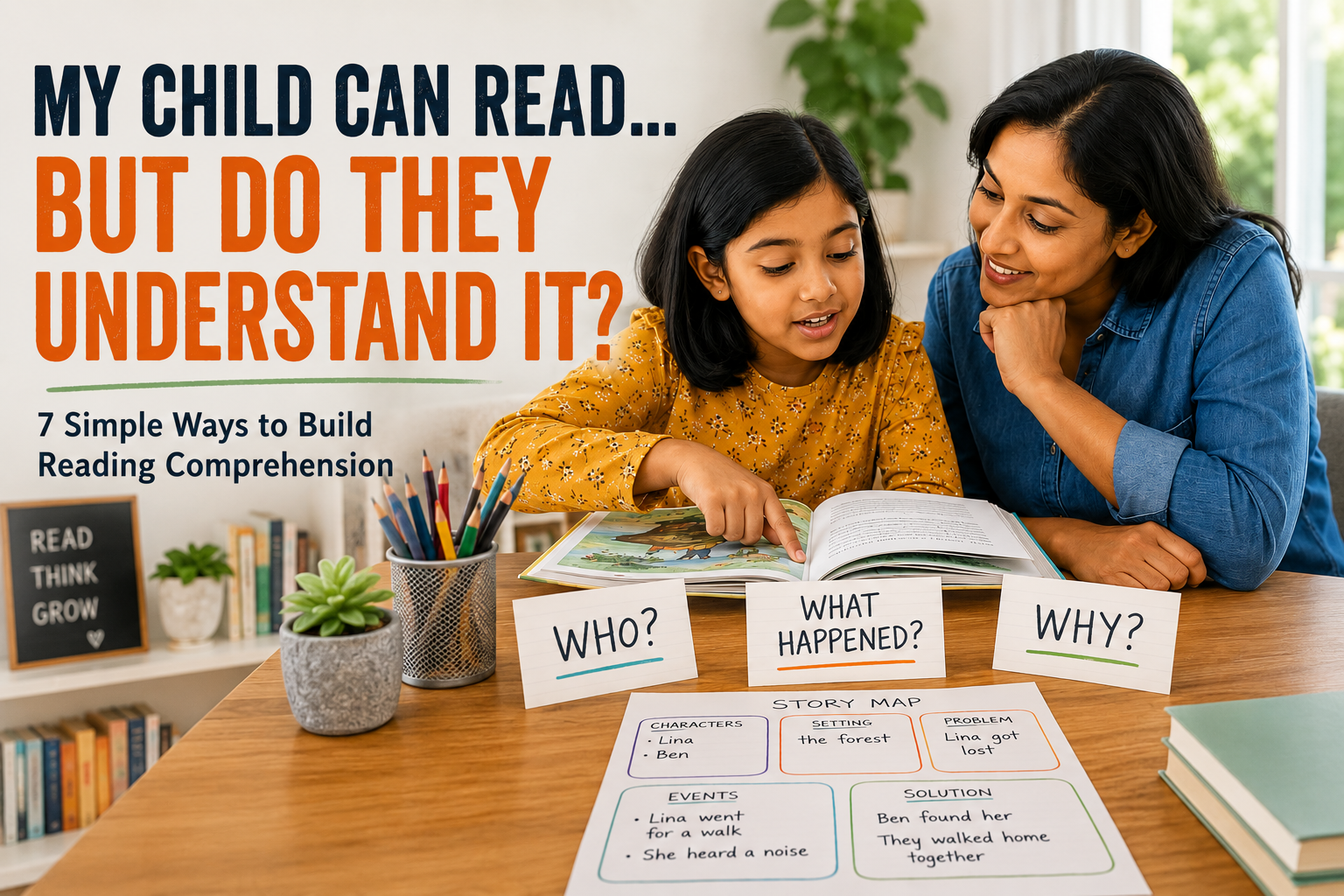
This is one reason story maps can be so useful. Story-structure instruction teaches children to recognize elements such as characters, setting, events, problems and resolutions.
Try the Five-Finger Retell
After reading, hold up one hand.
Each finger represents one thing to remember:
1 — Characters: Who was there?
2 — Setting: Where did it happen?
3 — Events: What happened?
4 — Ending: How did it finish?
5 — Favorite: What part did you like, dislike or find interesting?
Reading Rockets' comprehension activities for families recommends a similar five-finger retelling activity for young readers.
And there's another advantage to retelling: research summarized by Reading Rockets found story retelling associated with improvements in story-related comprehension and expressive vocabulary in young children.
2. Ask Questions During the Story
You don't have to wait until the book closes to discover that your child got lost eight pages ago.
Pause occasionally.
Not every paragraph.
Not every page.
And definitely not so often that your child begins hiding when you approach with a book. 😂
Just enough to keep the brain participating.
Ask:
What do you think is going to happen next?
Why do you think she did that?
Wait—what just changed?
How do you think he feels right now?
What makes you think that?
That final question is particularly powerful.
“What makes you think that?” teaches children that their ideas can come from evidence in the story.
Interactive read-aloud guidance from the Institute of Education Sciences similarly emphasizes discussion questions that move beyond surface-level recall and encourage children to think more deeply about meaning.
3. Let Your Child Predict—and Be Wrong
Prediction is one of my favorite comprehension activities because children often don't realize they're practicing reading.
Before turning a page, ask:
“What do you think happens next?”
Then keep reading.
Sometimes they're right.
Sometimes they're spectacularly wrong.
Both are useful.
The important conversation comes afterward:
“Ooooh. We thought he was going to hide. Why do you think he decided to tell the truth instead?”
Now the child is comparing expectations with new information.
You can also make predictions before opening the book.
Look at the cover.
Read the title.
Study the illustration.
Ask:
What do you think this story might be about?
You have just turned the cover into a thinking activity.
4. Make a “Movie” in Their Head
Some children can decode a paragraph beautifully without creating much of a mental picture.
Try this.
Read a descriptive passage aloud and say:
“Close your eyes. What would this look like if it were a movie?”
Then explore it.
What can you see?
What might you hear?
What would the place smell like?
Is it bright or dark?
How do you know?
Visualization helps children slow down enough to notice descriptive information rather than racing through the words.
Reading Rockets recommends a similar “mind movies” activity and suggests returning to the text to identify the words that helped create the imagined scene.
For artistic children, take this one step further:
Draw the scene.
Now reading comprehension has quietly become an art activity.
5. Don't Rescue Them From Every Confusing Part
Confusion isn't necessarily a problem.
Not noticing confusion is.
Good readers eventually learn to think:
Wait. That didn't make sense.
And then do something about it.
Your child can learn that habit too.
If something becomes confusing, teach a simple routine:
STOP → THINK → LOOK BACK
Stop reading.
Think about what became confusing.
Look back at the previous sentence, paragraph or picture for clues.
If necessary, reread it together.
The goal isn't to make children understand every sentence instantly.
It's to teach them what to do when they don't.
That's a skill they'll use long after elementary school.
6. Let Them Tell the Story Their Way
Here's where adults sometimes accidentally make comprehension harder.
We expect the child to reproduce the book.
That's not necessarily the goal.
Try:
“Tell me the three most important things that happened.”
Now your child has to decide what mattered.
For younger readers, use:
First → Next → Last
For more advanced readers:
Problem → Important Events → Solution
You can even hand them three sticky notes and let them draw one event on each.
Summarizing requires readers to identify important ideas and express them in their own words, making it a meaningful comprehension strategy rather than simply a memory exercise.
7. Bring the Story Into Real Life
One of the easiest ways to discover whether a child understood an idea is to see whether they can connect it to something else.
Suppose a character feels nervous about starting a new school.
Ask:
“Have you ever felt like that?”
A character loses something important.
“What would you do?”
Someone in the book makes a bad decision.
“Would you have made the same choice?”
There isn't always one correct answer.
That's the point.
Reading isn't only about retrieving information.
Stories give children a safe place to practice understanding motives, consequences, emotions, choices and perspectives.
And those conversations can become much richer than a worksheet full of multiple-choice questions.
A Simple 10-Minute Reading Comprehension Routine
You don't need a 45-minute literacy lesson every evening.
Try this instead.
Before reading — 1 minute
Look at the title and cover.
Ask:
“What do you think this will be about?”
Read — 5–6 minutes
Pause once or twice.
Ask one prediction or “why” question.
After reading — 3 minutes
Ask your child to tell you:
Who?
What happened?
Why did it matter?
Then choose one extension.
Draw a favorite scene.
Complete a story map.
Write an alternative ending.
Put three events in order.
Describe a character.
Answer a “what would you do?” question.
Done.
That is reading practice.
You do not need to squeeze every possible lesson out of every book.
Sometimes the best thing you can do for a developing reader is leave enough room for them to still enjoy reading.
Turn the Story Into Something Your Child Can Do
Some children process a story much better when they can move information out of their heads and onto something they can see.
That's where printable reading activities can help.
A good comprehension worksheet shouldn't simply ask twenty questions about a book.
It can help a child organize thinking.
For example:
Character → Problem → Events → Solution
or
Before I Read → While I Read → After I Read
or even:
Draw It → Tell It → Write It
That last format is especially useful for children who can explain an idea verbally or visually before they're ready to produce a long written response.
At Read With Me Club, we're building reading activities around exactly this idea: don't just finish the book—do something with the story.
Pair books with printable worksheets, creative activities and interactive learning experiences so children can explore what they've read in more than one way.
Frequently Asked Questions
Why can my child read fluently but not understand what they read?
Word reading and comprehension require overlapping but distinct skills. A child may become relatively good at decoding printed words while still needing support with vocabulary, background knowledge, inference, story structure, attention or summarizing. If the difficulty is persistent or significantly affecting schoolwork, discuss it with your child's teacher or reading specialist rather than assuming the child simply isn't paying attention.
Should I ask comprehension questions after every page?
Usually, no. Too many interruptions can turn enjoyable reading into an interrogation. Choose a few meaningful moments to predict, clarify, discuss vocabulary or explore a character's thinking.
Are reading comprehension worksheets helpful?
They can be when the worksheet supports a specific skill rather than becoming busywork. Story maps, sequencing activities, character analysis, prediction sheets and short-response prompts can make invisible thinking visible.
What should I do when my child says “I don't know”?
Make the question smaller.
Instead of repeating “What happened?” try:
“Who was on this page?”
Then:
“What were they doing?”
Then:
“Why?”
You can also return to the text together. Rereading isn't cheating. It's a reading strategy.
What age should children start practicing reading comprehension?
Comprehension begins before children can independently read. Talking about pictures, predicting what happens next, discussing characters and retelling familiar stories during read-aloud time are all early comprehension activities.
